
Magnesium Glycinate for Sleep and Anxiety: How One Supplement Tackles Both
SpartanShopper · April 19, 2026
Can magnesium glycinate help with both sleep and anxiety? Yes — and the science explains exactly why. Here's how one mineral deficiency may be driving both problems simultaneously.

If you've ever lain awake at 3am with your heart racing, thoughts spiraling, and a body that won't relax no matter how tired you are — you already know that anxiety and insomnia aren't two separate problems. They're the same problem wearing different faces at different times of day.
What most people don't know is that a single mineral deficiency is often driving both.
Magnesium glycinate for sleep and anxiety is one of the most evidence-backed applications of this supplement. It doesn't address anxiety and sleep as two separate conditions. It corrects a root-cause physiological imbalance that makes both worse and keeps them locked in a self-reinforcing cycle.
The Anxiety-Insomnia Loop
Here's how it typically works:
Anxiety activates your sympathetic nervous system — the "fight or flight" response. Cortisol and adrenaline rise. Your heart rate increases, your muscles tense, and your brain starts scanning for threats. This is adaptive in short bursts. But when stress is chronic, this system gets stuck in a low-grade activation state that doesn't fully switch off — even at night.
The result: you get into bed exhausted but wired. Your body is physiologically prepared for a threat that isn't there. Sleep becomes light, fragmented, or impossible. And the next day? Sleep deprivation makes anxiety worse, which makes that night's sleep worse, which makes anxiety worse again.
This is the loop that traps millions of people. And magnesium deficiency is one of the most underappreciated accelerants of it.
How Magnesium Deficiency Fuels Both Anxiety and Insomnia
Magnesium is essential for the function of two of your body's most important calming systems:
GABA — Your Brain's Off Switch
GABA (gamma-aminobutyric acid) is the primary inhibitory neurotransmitter in your brain. It's what tells your nervous system to slow down, relax, and stop processing at full intensity. Prescription sleep medications and anti-anxiety drugs work largely by enhancing GABA activity — which gives you a sense of how central this system is to both sleep and anxiety.
Magnesium is required to activate GABA receptors effectively. When magnesium is low, GABA activity is reduced, and your nervous system loses one of its key braking mechanisms. The result is a brain that stays in a higher state of excitability — manifesting as anxiety during the day and racing thoughts at night.
The HPA Axis — Your Stress Response System
The hypothalamic-pituitary-adrenal (HPA) axis is the hormonal system that regulates your response to stress. When magnesium levels are adequate, it acts as a natural brake on the HPA axis — limiting cortisol release and helping your body return to baseline after a stressor.
When magnesium is depleted, this brake weakens. The HPA axis becomes hyperreactive: you produce more cortisol in response to smaller stressors, and that cortisol stays elevated longer. Since cortisol is strongly suppressive of sleep, chronically elevated evening cortisol is one of the most direct drivers of both anxiety and insomnia.
The cruel irony: cortisol also depletes magnesium. More stress → less magnesium → weaker cortisol brake → more stress. It's a spiral — and it's very common.
What the Research Shows
A systematic review published in PMC examining 15 clinical studies found that the majority demonstrated improvement in at least one sleep or anxiety-related parameter with magnesium supplementation. Five out of seven studies measuring anxiety-related outcomes reported improvements in self-reported anxiety.
For sleep, a randomized controlled trial published in the Journal of Research in Medical Sciences found that magnesium supplementation significantly improved insomnia severity scores, sleep efficiency, sleep onset time, and early morning awakening — along with measurable improvements in serum melatonin and cortisol levels.
The glycine component adds an additional layer: separate research on glycine specifically has found that it independently reduces core body temperature, improves subjective sleep quality, and reduces daytime fatigue — and has been shown to reduce anxiety symptoms in clinical settings.
Signs That Magnesium Deficiency May Be Driving Your Anxiety and Sleep Problems
You may be dealing with magnesium-related anxiety and insomnia if you recognize several of these patterns:
Anxiety patterns:
- Anxiety that's worse at night than during the day
- Physical manifestations of anxiety — muscle tension, tight jaw, heart palpitations, restless legs
- Anxiety that spiked after a period of prolonged stress
- Sensitivity to noise, light, or stimulation
- Feeling "wired but tired" — exhausted but unable to relax
Sleep patterns:
- Racing thoughts the moment your head hits the pillow
- Physical tension that prevents falling asleep
- Waking between 2–4am
- Light, unrefreshing sleep even when duration is adequate
- Sleep that deteriorated during a stressful period and never fully recovered
General patterns:
- Chocolate cravings — dark chocolate is high in magnesium
- Muscle cramps or eye twitches
- Fatigue that sleep doesn't fully resolve
- Symptoms worsen before menstruation — magnesium drops in the luteal phase
Why Magnesium Glycinate Specifically for Anxiety and Sleep
For anxiety and sleep specifically, the glycinate form matters — not just any magnesium.
Magnesium glycinate offers three distinct advantages over other forms:
Superior Bioavailability
The glycine bond dramatically improves absorption, meaning more magnesium reaches your brain compared to oxide or citrate forms. For neurological applications like GABA support, this matters significantly.
Glycine's Independent Calming Effect
Glycine is itself an inhibitory neurotransmitter in the brain and spinal cord. It reduces neural excitability, lowers core body temperature, and has been shown to reduce anxiety symptoms in clinical settings. You're essentially getting two calming agents in one compound.
No Digestive Disruption
Anxiety and gut health are deeply interconnected through the gut-brain axis. Magnesium forms that cause GI distress can paradoxically worsen anxiety in people with gut sensitivity. Magnesium glycinate eliminates this problem.
Read our full comparison: Magnesium Glycinate vs. Melatonin
Building a Complete Evening Protocol for Sleep and Anxiety
Magnesium glycinate works best as part of a layered approach. Here's a protocol that addresses both anxiety and insomnia from multiple angles:
Morning
- Consistent wake time — even on weekends — anchors your circadian rhythm
- Morning sunlight exposure resets your cortisol and melatonin timing
Afternoon
- Limit caffeine after 1pm
- Brief physical movement — even a 10-minute walk meaningfully lowers baseline cortisol
Evening
- Limit news and social media 60–90 minutes before bed
- Reduce screen brightness and blue light exposure
Bedtime — 30–60 Minutes Before Sleep
- 200–400mg elemental magnesium glycinate
- Warm drink ritual — signals safety and end-of-day to your nervous system
- Brief breathing or body scan practice — activates the parasympathetic nervous system, complementing the magnesium's neurological effects
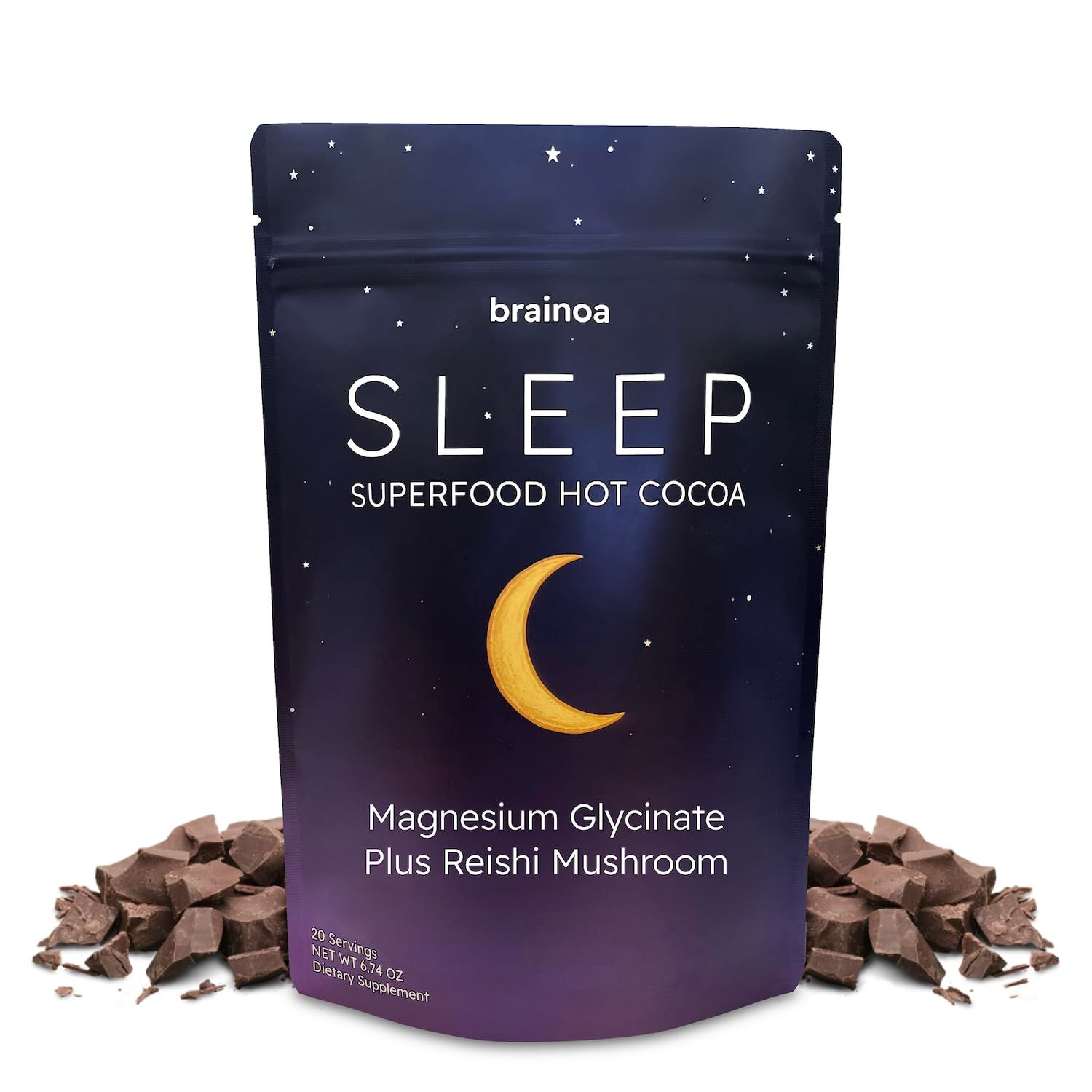
The combination of magnesium glycinate and ashwagandha is particularly powerful for anxiety-driven insomnia. Magnesium works on the neurological side (GABA, neural excitability), while ashwagandha works on the hormonal side (cortisol, HPA axis). Together they cover both the "busy brain" and the "stress response" components of anxiety-related sleep disruption — which is exactly why Brainoa Sleep Cocoa combines both.
Exclusive Deal
20% Off Brainoa Sleep Cocoa — Magnesium Glycinate Bedtime Hot
Amazon
Save 20% on Brainoa Sleep Superfood Hot Cocoa — the bedtime drink with magnesium glycinate, ashwagandha, reishi mushroom and L-theanine for deep, natural sleep. No melatonin, no added sugar, no artificial flavors. Vegan and gluten free. 4.1 stars on Amazon. Perfect for chocolate lovers who want a natural sleep aid without grogginess.
Expires May 1, 2026
Shop Brainoa Sleep Cocoa on Amazon
How Long Until You Feel Better?
- Anxiety symptoms often begin to improve earlier than sleep — some people notice reduced reactivity and a calmer baseline within 1–2 weeks
- Sleep improvements typically build more gradually — 2–3 weeks for meaningful improvement, 4–6 weeks for the full effect
- The anxiety-sleep loop tends to break in one direction first, which then allows the other to improve. Better sleep makes anxiety more manageable. Less anxiety makes sleep easier.
Important Considerations
Magnesium glycinate is a supplement, not a treatment. For clinical anxiety disorders — GAD, panic disorder, PTSD, OCD — please work with a qualified mental health professional. Magnesium can be a valuable adjunct to therapy and medication, but it is not a substitute.
If sleep problems persist despite 6+ weeks of magnesium glycinate, consider evaluation for sleep apnea — which is underdiagnosed, particularly in women — or for anxiety disorders that may benefit from evidence-based therapy.
See our dosage guide for full dosing recommendations
The Bottom Line
Anxiety and insomnia share deep neurological and hormonal roots — and magnesium deficiency weakens the biological systems that regulate both simultaneously. Magnesium glycinate, with its superior bioavailability and glycine's added calming properties, addresses multiple pathways at once: GABA activation, cortisol regulation, neural excitability, and the physical tension that both anxiety and sleep deprivation produce.
For people caught in the anxiety-insomnia loop, this isn't just a sleep aid or an anxiety supplement. It's a nutritional correction for a systemic imbalance that's been making both conditions worse.
Give it four to six weeks. Stack it with ashwagandha if cortisol-driven wakefulness is part of your picture — or use a pre-formulated combination like Brainoa Sleep Cocoa. Be patient. And pay attention to which direction the loop breaks first — because understanding that will tell you a lot about where your deepest imbalance lies.
RELATED ARTICLES
Magnesium Glycinate for Sleep: The Natural Melatonin Alternative
How Much Magnesium Glycinate Should I Take for Sleep?
Magnesium Glycinate for Sleep — Women Over 40
DISCLAIMER
This article is for informational purposes only and is not a substitute for professional medical or mental health advice. If you are experiencing significant anxiety or insomnia, please consult a qualified healthcare provider.
Disclosure: SpartanShopper participates in the Amazon Associates program and may earn a commission on qualifying purchases at no extra cost to you.
Related Coupons

Amazon
20% Off
20% Off Brainoa Sleep Cocoa — Magnesium Glycinate Bedtime Hot
Save 20% on Brainoa Sleep Superfood Hot Cocoa — the bedtime drink with magnesium glycinate, ashwagandha, reishi mushroom and L-theanine for deep, natural sleep. No melatonin, no added sugar, no artificial flavors. Vegan and gluten free. 4.1 stars on Amazon. Perfect for chocolate lovers who want a natural sleep aid without grogginess.
Expires: 5/1/2026
Shop Now →
Amazon
50% off
50% Off ZERONDER Ear Wax Removal Tool with Camera (Code: 2TLPZR2S)
Save 50% on the ZERONDER I35R ear wax removal tool with flexible camera otoscope. Visual ear pick with tweezers, wax remover, and ear cleaning kit for the whole family. Compatible with iOS and Android. Use code at checkout while supplies last.
Expires: 4/22/2026
Shop Now →